Navajo County Solar + Storage
Accountability. Stewardship. Tangible Community Investment.
_2000px.jpg)
AZ homes powered annually (Phase 1)
To local agencies over project lifetime
Construction jobs
Community benefit fund commitment
we want to invest in Navajo County
Clearway Energy Group is developing Chimney Canyon Energy Center, a solar and energy storage project on privately leased land in Navajo County, Arizona -- about five miles south of Joseph City. As developer and long-term owner operator, we are taking steps to be an accountable neighbor, helping preserve Navajo County’s unique culture and landscape through responsible stewardship of the land and tangible community investment.
Phase 1 of the Chimney Canyon Energy Center includes 600 megawatts (MWac) of photovoltaic solar generation and a 375 MW energy storage system, connected to the regional energy grid under contract with an Arizona utility. The project is currently moving through Navajo County's permitting and public hearing process under the newly revised renewable energy ordinance.
Accountable development
We are directly responding to what we’ve heard from the community to build a project that minimizes impacts and isprepared for every scenario. Click each item below to learn more about our plans for Chimney Canyon Energy Center.
Co-existing with nature
We pledge to treat the environment with respect, not only for the private landowners we lease from but for the neighbors who love the Navajo County landscape and wildlife.
Chimney Canyon Energy Center's design is being informed by direct guidance from the Arizona Game & Fish Department and Navajo County to allow area wildlife to pass through the area and minimize habitat impacts.
Habitat avoidance:
- Thorough multi-year habitat survey found no evidence of threatened or endangered listed species on project land.
- Sited to avoid floodplains and ephemeral washes, exceeding federal requirements for protection of aquatic resources.
- Transmission line sited along existing corridors to extent possible to minimize habitat fragmentation impacts.
- Solar area split into multiple smaller arrays to avoid environmentally sensitive areas.
Large game migration:
- Large migration corridor running through full project to accommodate large game like pronghorn and elk along existing natural migration routes (i.e. ephemeral drainages). The corridor's width ranges from 1,300 to 3,000 feet across, exceeding per Arizona Game & Fish Department's direct recommendations for a 1,300-foot-corridor.
- Additional smaller corridors may also be included which would provide more options for wildlife moving through the site and reduce bottlenecks.
- Unfenced areas between solar arrays arranged to avoid "dead ends," with rounded corners on fenced-in areas where needed to guide wildlife through and prevent entrapment.
Birds and small animals:
- 6-to-8-inch gap below fencing to allow small wildlife to enter and pass through the site unimpeded.
- A qualified biologist will conduct pre-construction wildlife surveys and provide environmental compliance monitoring during construction activities. This will include pre-construction nesting surveys (in accordance with Migratory Bird Treaty Act), which will set buffers around any active nests and avoid disturbance until young have fledged.
- Any lighting will be shielded and point downwards to reduce impacts to nocturnal species and preserve dark skies. Motion-sensor activation help keep the lights off except when needed by workers.
- Transmission lines are Avian Power Line Interaction Committee compliant to ensure safety for birds.
Responsible water use
Protecting water should be apriority for everyone in Arizona, including energy producers. The county's ordinance requires developers to submit a preliminary water resource study identifying all water sources/watercourses and impacts.
The Chimney Canyon Energy Center will access water from an existing well on-site. We are estimating our water use to be:
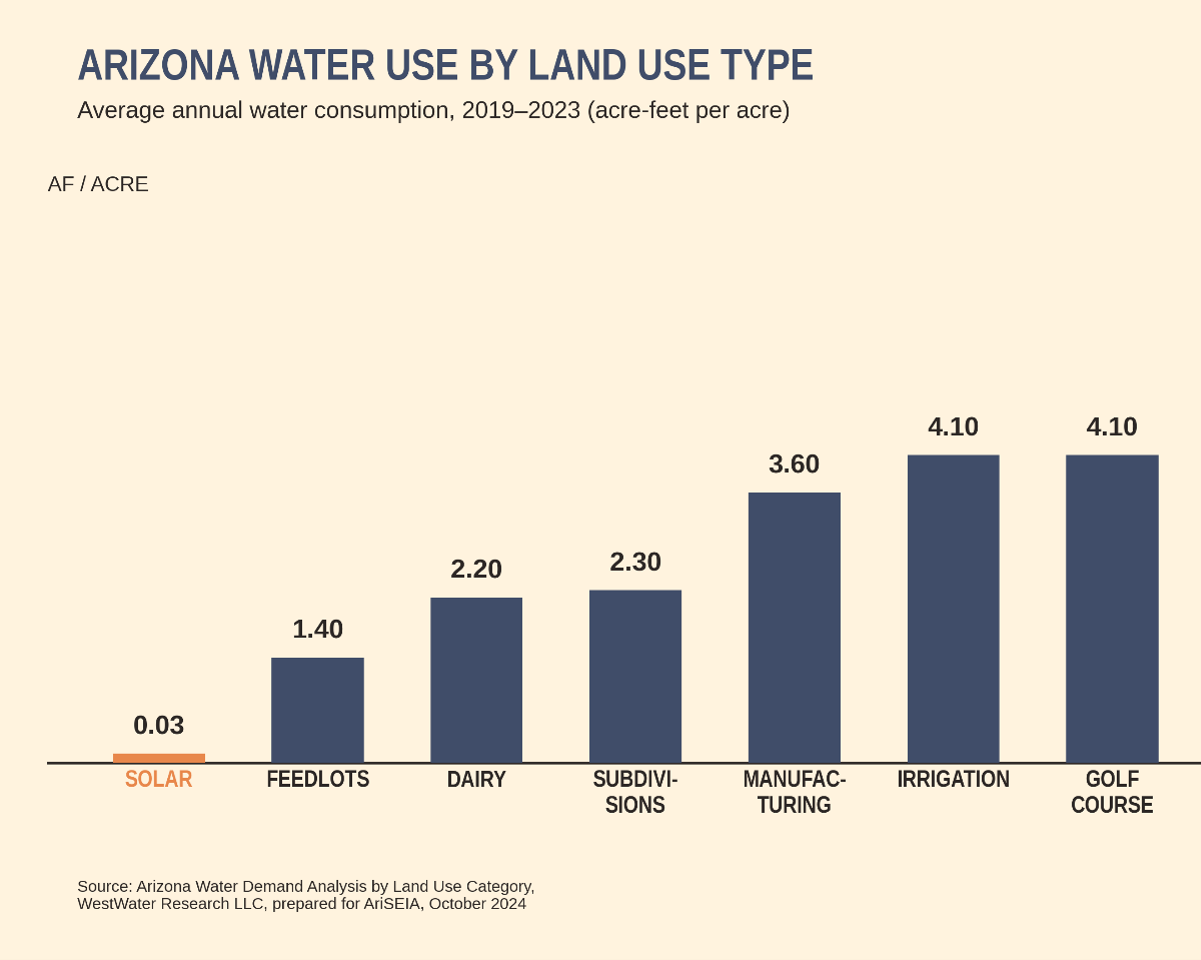
- Conservative estimate of - 0.02-0.3 acre-feet per acre during construction, used for dust control. That is roughly eight times less than single-family residential subdivision water use per acre.
- - Operational water use will be near zero. A typical Arizona solar farm uses roughly 0.001-0.03 acre-feet per acre for annual panel washing, about 80 times less than residential use. The Chimney Canyon site should not require panel washing most years.
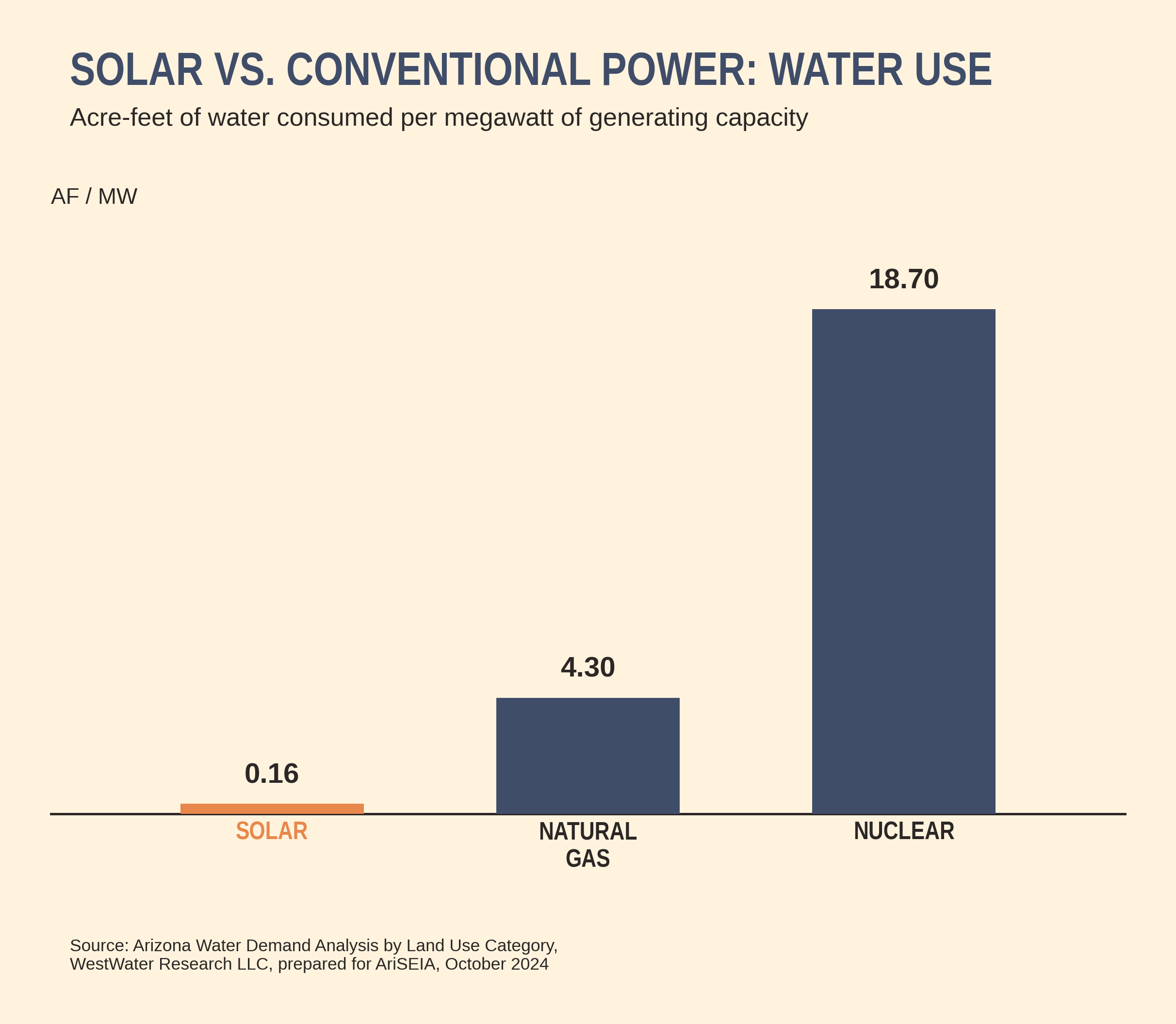
Photovoltaic solar is among the least water-intensive ways to generate electricity — using thousands of times less water than a traditional power plant.
Building for safety
Safety is Clearway’s #1 core value, with multiple layers of protection built into every facility we design and operate. We believe that everyone in Navajo County must do their part to prevent brush fire – including us.
In addition to coordinating with local fire authorities for emergency preparedness, we design our facilities following best practices for fire mitigation.
Battery storage systems in particular are highly regulated. Clearway builds several layers of protection into every facility, including:
- Strict adherence to all relevant codes and standards including NFPA 855 (the national fire code for energy storage) and UL 9540A, which tests batteries for fire safety.
- Using batteries with advanced chemistry rated for higher temperatures.
- Batteries sit in highly-engineered individual enclosures with built-in monitoring and detection to deploy automatic shutoff if batteries overheat.
- In the unlikely event of a fire, the enclosures also prevent spread between parts of the system.
Emergency preparedness
While we don't expect fires or other safety incidents at the Chimney Canyon Energy Center, it's our responsibility to make sure local first responders are prepared for every scenario.
Per the county ordinance, we are coordinating with local fire departments to ensure they are aligned with our plans and prepared for any scenario. Our executed Fire Service Agreement with Joseph City Fire Department includes $10,000/year in funding, plus annual training covering site layout, access points and technology-specific hazards.
We will also submit a Fire Safety Plan and Emergency Management Plan, which would become enforceable under our negotiated Development Agreement.
Living groundcover
When a solar farm is treated like a living landscape, soil stays healthier, preventing stormwater management and dust control issues.
We are required to implement a Stormwater Pollution Prevention Plan and best soil management practices in compliance with the Arizona Department of Environmental Quality. This includes revegetating at least 70% of the site, using native plants where possible, to stabilize soil, hold onto moisture and foster biodiversity.
We've also asked our construction contractor to hold onto topsoil during construction for later redistribution, which preserves the seed bank and allows for faster return to existing conditions.
End-of-life & decommissioning
Restoring the land at the end of a project’s life should always be the owner's responsibility — not the community's. As the long-term owner, Clearway is responsible for every step of decommissioning: removing and recycling equipment and re-vegetating the site. Per Navajo County's requirements, we'll post a security bond with a regulated financial institution to fund this work, payable on demand.
Economic impact
With Arizona utilities preparing for significant demand increases, Navajo County has an opportunity to grow its local economy by turning abundant sunshine into limitless fuel for low-cost in-state energy generation.
Chimney Canyon Energy Center represents major investment in the county's economy — funded entirely by private capital, not taxpayer dollars.
.jpg)


$1 million community benefit fund
Clearway pledges to contribute $1 million to community initiatives in Navajo County by the time Chimney Canyon Energy Center goes online.
In partnership with our construction contractor SOLV, we are currently planning projects that support education and energy resilience for local families.
"I hope to leave a legacy of honor, a legacy of pride."
Get in Touch
The Clearway team wants to hear from you. Please fill out this form or email chimneycanyonsolar@clearwayenergy.com to get in touch.